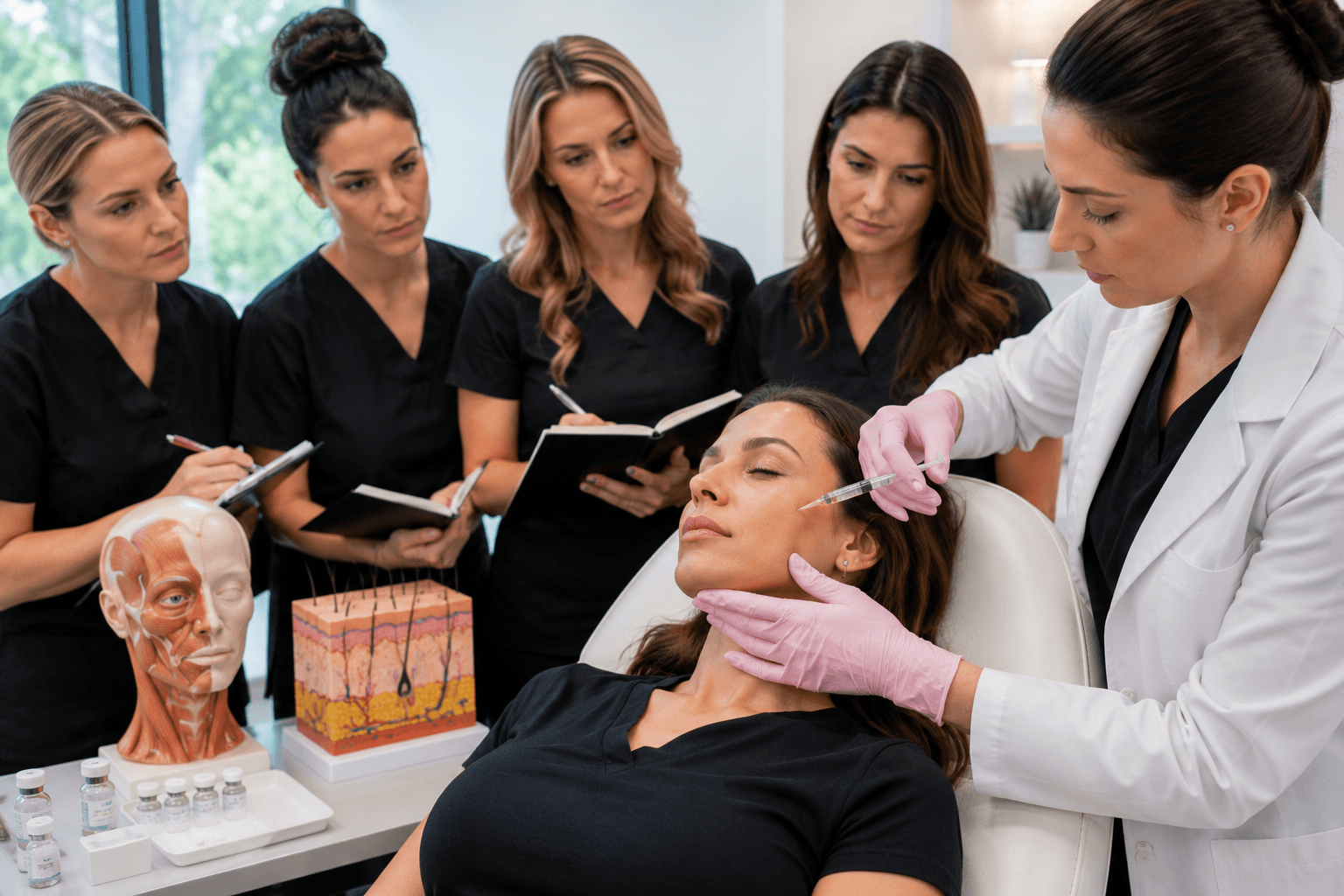

Hyaluronic acid fillers are the workhorse of many aesthetic practices, and for good reason. They deliver visible results quickly, they are versatile, and patients understand them. But experienced injectors know that not every volume concern is best solved with more filler. Sometimes the patient needs structure. Sometimes they need better skin quality. And sometimes they need a slower, collagen-building approach that a traditional filler cannot provide.
This article looks at how dermal fillers and biostimulators differ, which patient concerns point toward each, how to talk patients through the choice, and how providers in Needham can build skill with biostimulatory technique.
How Do Dermal Fillers and Biostimulators Work Differently?
Hyaluronic acid fillers add volume directly by occupying space and attracting water, so results are visible right away. Biostimulators such as poly-L-lactic acid work by encouraging the body to produce its own collagen over time, so results build gradually over several sessions. They solve related problems in very different ways.
The FDA's overview of FDA-approved dermal fillers describes the main categories of filler materials, including poly-L-lactic acid, which it notes is delivered in a series of injections over several months with effects that may last up to two years. Understanding these mechanisms helps you match the product to the concern rather than defaulting to what is most familiar.
Which Patient Concerns Point Toward a Hyaluronic Acid Filler?
Hyaluronic acid fillers tend to fit patients who want targeted, immediate change in specific areas, such as lips, defined lines, or precise contour enhancement. They are also useful when a patient wants a result for a near-term event or prefers the option of adjustment.
Patients with localized concerns, good skin quality, and a clear goal often do well with HA fillers. The immediate result can be reassuring, especially for first-time patients who want to see change before committing to more.
When Might a Biostimulator Be the Better Choice?
A biostimulator may be the better choice when volume loss is diffuse, skin quality has declined with collagen loss, or a patient prefers gradual, natural-looking change over several months. It may also be worth considering for patients who have had repeated filler treatments but still feel their face looks tired or heavy.
Diffuse facial volume loss
When volume loss is spread across several facial zones, the decision is less about any single area and more about the overall treatment strategy. Placing filler in every area can add up to heaviness, while a collagen-stimulating approach treats broader areas more gradually. For the clinical background on volume loss itself, see why cheeks hollow with age and how Sculptra can help.
Declining skin quality
Collagen loss affects not only volume but also skin thickness and firmness. Biostimulators are designed to support collagen production over time, which is why many injectors consider them for patients whose skin feels thinner or less resilient.
Patients who want subtle, gradual change
Some patients worry about looking "done." A treatment that builds slowly can feel less noticeable to friends and colleagues, which appeals to patients who value discretion.
Can Fillers and Biostimulators Be Used Together?
Yes. Many injectors combine approaches, using a biostimulator for broader collagen support and a hyaluronic acid filler for targeted refinement. Combination planning requires careful sequencing, product knowledge, and a clear explanation of the timeline so the patient understands what to expect.
The key is building a treatment plan around the patient's anatomy and goals rather than around a single product. That kind of planning comes with experience and is one of the clearest differences between newer and more advanced injectors.
What Safety Considerations Apply to Both Approaches?
Both fillers and biostimulators carry risks that every injector must understand, including vascular complications, nodules, and the importance of proper technique and product preparation. Thorough anatomical knowledge and supervised practice reduce, but never eliminate, these risks.
The FDA's dermal filler safety information warns that unintentional injection into a blood vessel can lead to serious complications, including tissue death, vision abnormalities including blindness, and stroke. It also cautions against using needle-free devices for filler injection. With poly-L-lactic acid, correct reconstitution and injection technique are important for reducing the risk of nodules, which is one reason structured, hands-on training matters.
Product preparation is where biostimulators differ most from ready-to-inject hyaluronic acid syringes. Poly-L-lactic acid arrives as a powder that must be reconstituted, and the dilution volume, hydration time, and mixing technique all influence how evenly the product disperses once injected. Placement depth and distribution matter as well, since product concentrated in one spot is more likely to form palpable nodules. Post-treatment instructions, including the massage guidance many injectors give patients, are part of the same safety picture. These details are easy to underestimate when you are used to HA fillers, which is why supervised practice with an experienced trainer is valuable before treating patients independently.
How Should Different Injectors Approach This Decision?
Where you are in your career shapes how you approach the filler versus biostimulator decision. New injectors often focus on mastering one product category well, while experienced injectors and practice owners benefit from expanding into combination planning and biostimulatory technique.
New aesthetic injectors usually do best building confidence with foundational products and assessment skills first. Observing an experienced provider through the Basic Shadowship lets you observe a variety of procedures in a working aesthetic practice.
Experienced injectors who feel they rely too heavily on HA fillers often find that learning a biostimulator broadens their options for patients with diffuse volume loss.
Nurse practitioners and physician assistants building an aesthetic practice may find that longer-term plans combining approaches are a natural fit for their practice.
Physicians transitioning into aesthetics may appreciate the mechanism-driven reasoning behind choosing a biostimulator and the clinical judgment involved in planning.
Medspa owners can broaden their service menu by making sure their injectors understand both categories and follow consistent assessment standards.
What Does Sculptra Training in Needham Include?
Elite Academy's Sculptra: Beyond the Label (Face + Body) is a half-day, in-person, hands-on course in Needham. It covers anatomical assessment and mapping, reconstitution methods, injection techniques tailored to each area, and supervised injections on various facial and body areas. The course addresses both on- and off-label applications.
The Sculptra product page names the buttocks, arms, and knees among the areas where advanced techniques are taught. Sculptra Aesthetic's FDA approval covers specific facial indications, so body applications are off-label and call for thorough training, informed consent, and clinical judgment. You can review Sculptra's approval history in the FDA premarket approval database.
Elite Academy is led by Dr. Joelle Lieman, a Board Certified Obstetrician and Gynecologist and member of the American Academy of Aesthetic Medicine. Training takes place at 1 Chapel St in Needham, a Norfolk County town west of Boston. Visiting providers can find nearby hotels and parking details on the Where to Stay page.
Experienced injectors who want broader support with clinical skills and practice growth can also explore Elite Mentorship+.
What Should You Confirm About Scope of Practice?
Who can perform dermal filler and biostimulator injections in Massachusetts depends on licensure, supervision, and board rules. Completing a course does not on its own authorize a provider to perform a procedure, so confirm your scope before adding new treatments.
Physicians can consult the Massachusetts Board of Registration in Medicine, nurses and nurse practitioners can consult the Massachusetts Board of Registration in Nursing, and physician assistants can consult the Massachusetts Board of Registration of Physician Assistants.
Frequently Asked Questions
What is the difference between dermal fillers and Sculptra?
Hyaluronic acid fillers add volume immediately, while Sculptra is a poly-L-lactic acid biostimulator that encourages collagen production gradually over a series of sessions.
Is Sculptra a dermal filler?
Sculptra is often grouped with dermal fillers, but it works differently. Rather than filling space directly, it stimulates the body's own collagen over time.
Can you combine Sculptra and hyaluronic acid fillers?
Yes. Many injectors combine them, using Sculptra for broader collagen support and HA fillers for targeted refinement, with careful planning and sequencing.
When is a biostimulator better than a filler?
A biostimulator is often considered for diffuse volume loss, declining skin quality, or patients who prefer gradual, natural-looking change.
Where can injectors learn Sculptra technique in Needham?
Elite Academy offers Sculptra: Beyond the Label (Face + Body), a half-day, hands-on course held at its Needham training location at 1 Chapel St.
Fill Smarter, Not Just More
The most skilled injectors are not defined by how much product they use but by how well they match the tool to the concern. Knowing when a filler is the right answer, and when a biostimulator or combination plan will serve the patient better, is one of the clearest marks of an advancing practice.
Ready to add biostimulatory technique to your skill set? Explore Sculptra: Beyond the Label (Face + Body) or browse all Courses + Programs. For questions, contact the Elite Academy team or visit the Elite Academy homepage.