Updated August 2026.
If you are a nurse, nurse practitioner, physician assistant, or physician thinking about adding cosmetic injectables to your practice, you have probably already run into the same wall a lot of clinicians hit. Patients ask about services you are not yet confident offering, the online course landscape is confusing, and nobody wants to be the reason a real patient has a bad outcome while you are still figuring things out. That hesitation is healthy. It is also solvable, and clinicians in and around Needham, Massachusetts have a genuine, structured path to work through it.
This article walks through what that path actually looks like, from your first exposure to injectable work all the way to running a confident, independent injectable practice.
Why Do So Many Clinicians Hesitate Before Offering Cosmetic Injectables?
If you have been sitting on the idea of offering dermal fillers, neuromodulators, or biostimulators for a while without acting on it, you are not alone. A few concerns come up again and again among nurses and providers exploring aesthetic training for the first time.
What happens when a patient asks for a treatment you are not trained in?
This is often the moment that pushes clinicians to finally look for training. A patient mentions Kybella for submental fullness, or asks about Sculptra for facial volume loss, and you realize you do not yet have the hands-on repetitions to say yes with confidence. Turning patients away, or worse, attempting a technique you only learned from a video, are both outcomes worth avoiding.
How do you choose which injectable modality to learn first?
Cosmetic injectables cover a wide range of products and techniques, from neuromodulators to dermal fillers to biostimulators like Sculptra to regenerative approaches involving PRP. Trying to learn everything at once usually means learning nothing well. The clinicians who progress fastest tend to pick a starting point, build real competence, then expand.
Is a weekend certificate course enough to start injecting safely?
A one or two day certificate weekend can introduce terminology and basic concepts, but it rarely includes enough live patient repetition to build true injector confidence. There is a meaningful difference between watching a demonstration and actually performing the technique, under supervision, on a real face, multiple times. That gap is exactly where a lot of new injectors get stuck.
How do you go from watching to practicing without putting a patient at risk?
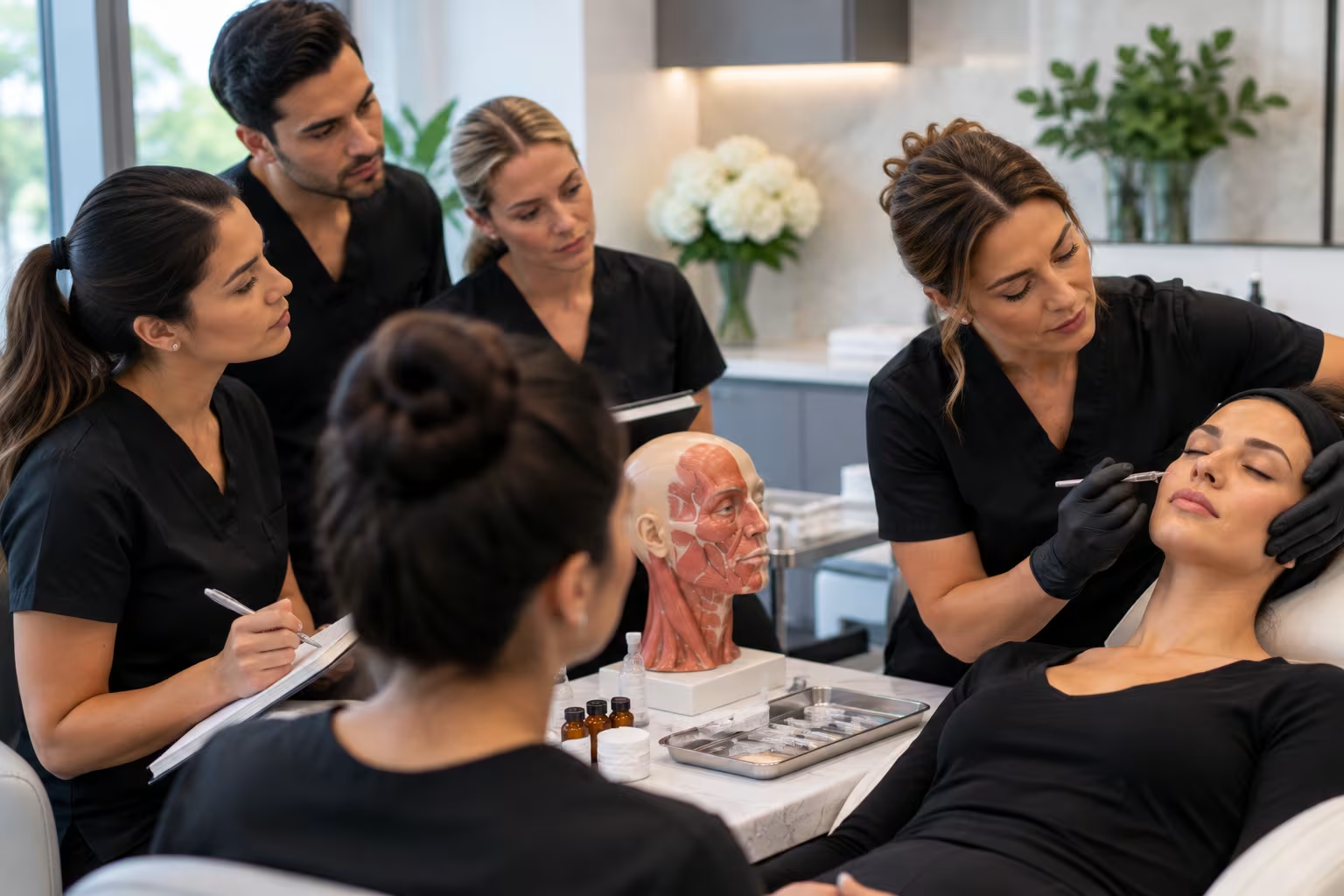
This is the core question. The safest route is a graduated one: observe first, then practice hands-on in a controlled setting with direct supervision, then continue building skill and business judgment over time. Skipping straight from a lecture to solo practice on patients is where avoidable complications happen.
What Does a Legitimate Path Into Cosmetic Injectables Training Actually Look Like?
A responsible training path for cosmetic injectables generally moves through three stages, and understanding them helps you evaluate any program you are considering, not just one in particular.
Stage one: shadowing and observation
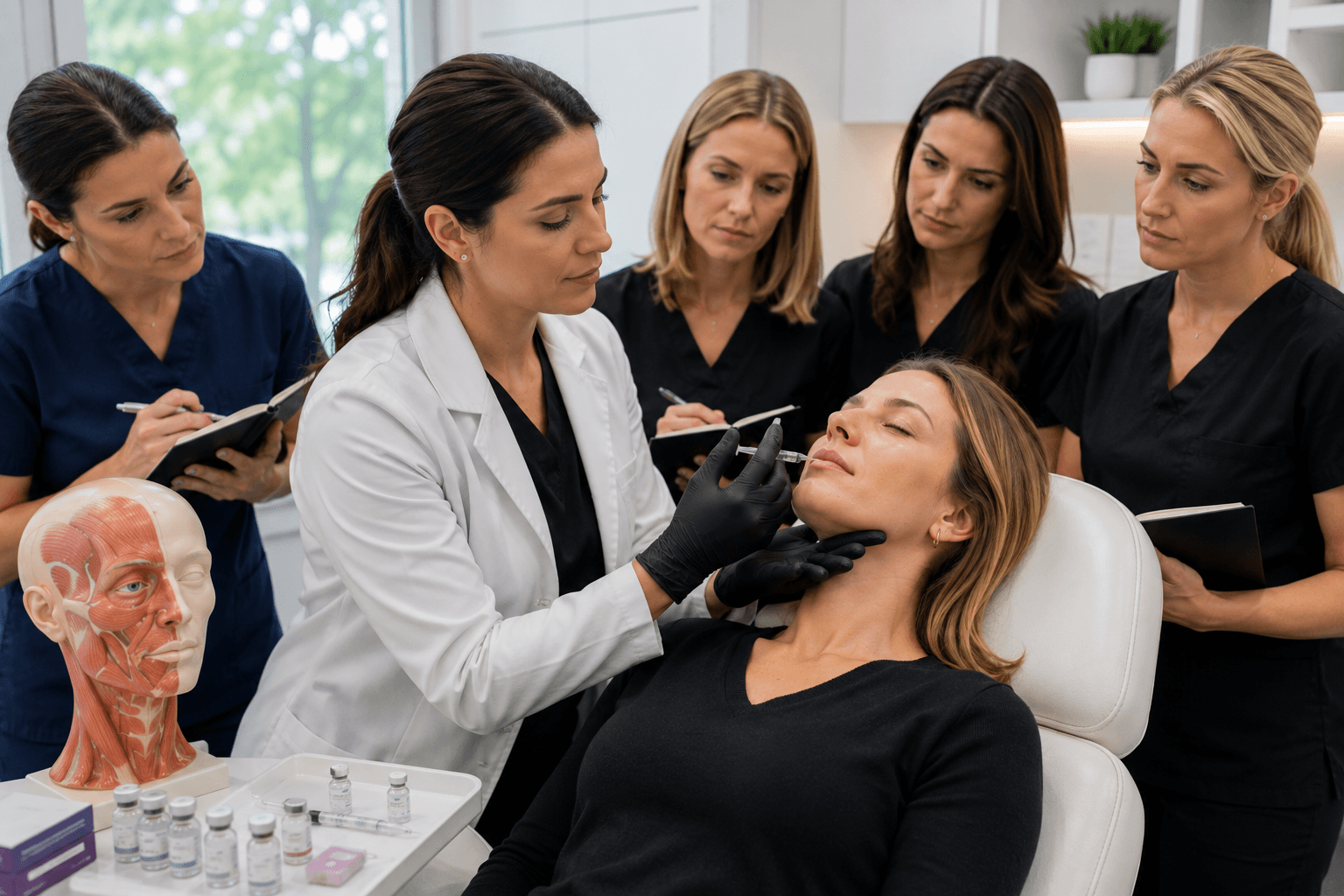
Before you ever pick up a needle in a training setting, it helps enormously to simply watch an experienced injector work. You see patient consultations, product selection, injection technique, and how complications are managed in real time, before you are the one making those decisions. This stage is about pattern recognition and building a realistic picture of the work.
Stage two: hands-on, modality-specific training
Once you understand what the work involves, the next step is hands-on practice in a specific modality, ideally under direct, in-person supervision rather than through a self-paced video course. This is where you build actual technique, not just theoretical knowledge.
Stage three: ongoing mentorship for business and clinical growth
Learning to inject is only part of building a real practice. Pricing your services, marketing yourself responsibly, managing patient expectations, and expanding your treatment menu over time all require a different kind of guidance, ideally from someone who has already built a successful injectable practice.
Where Can You Train in Cosmetic Injectables Near Needham, Massachusetts?
Elite Academy was built specifically around this three-stage progression, and its hands-on training takes place in person in Needham, Massachusetts. The academy was founded by Dr. Joelle Lieman, a board-certified OB/GYN and member of the American Academy of Aesthetic Medicine, who has run Elite Academy for more than ten years and trained over 100 healthcare professionals. You can read more about her background and the academy's mission on the About page. Elite Academy exclusively trains licensed healthcare professionals, meaning physicians, PAs, NPs, and RNs, rather than the general public, so every session is built around clinicians who are serious about practicing safely.
What if you are completely new to cosmetic injectables?
If you have little or no hands-on exposure yet, the Basic Shadowship is designed as that first stage. It is a half-day, in-person observation experience directly with Dr. Lieman, giving you a realistic look at how patient consultations, treatment planning, and injection technique come together before you commit to a full hands-on program. You can see the full details on the Basic Shadowship course page.
What if you already know you want to specialize in a specific modality?
For clinicians ready to move into stage two, Elite Academy offers dedicated, hands-on aesthetic training in specific modalities. The Sculptra: Beyond the Label course covers advanced biostimulator technique for both face and body, useful for injectors who want to expand their dermal fillers and volumizing offerings beyond the basics. The Vampire Series is an intensive, hands-on PRP training program for clinicians interested in regenerative treatments. Both are built around real repetition rather than passive observation.
What if you are already injecting but want to grow a real practice?
Experienced injectors who have the basics down but want to elevate their skills and build a sustainable business should look at Elite Mentorship+, a three-month program covering business development alongside clinical skill elevation across a range of injectable modalities, all in the context of running a real practice. This is stage three, and it is where many clinicians finally close the gap between knowing how to inject and knowing how to run a thriving aesthetic practice.
What Should You Expect From In-Person Training in Needham, Massachusetts?
Needham gives Elite Academy's programs a setting where hands-on, in-person instruction is the standard rather than the exception. Instead of a screen and a certificate at the end, you get direct time with Dr. Lieman, real technique correction, and the kind of feedback that only comes from someone watching your hands as you work. For clinicians throughout the greater Boston area, that proximity makes it realistic to build a relationship with a mentor over time, rather than a single weekend transaction.
Who Is a Good Fit for This Kind of Cosmetic Injectables Training?
This path suits licensed healthcare professionals at a few different points in their journey. It fits the nurse or NP who has heard about cosmetic injectables but has never observed a live injection appointment. It fits the newer injector who has done a basic course but wants real hands-on repetitions in a specific modality like Sculptra or PRP. And it fits the established injector who is confident clinically but wants structured mentorship to grow the business side of their practice. What ties all three together is a shared goal: delivering safe, exceptional care rather than rushing toward a service menu you are not fully prepared to support.
Frequently Asked Questions
Do I need any prior injectable experience to start with the Basic Shadowship? No. The Basic Shadowship is designed as an entry point for clinicians who are new to cosmetic injectables and want to observe real patient care before committing to hands-on training.
What is the difference between Sculptra training and general dermal filler training? Sculptra is a biostimulator that works differently from traditional dermal fillers, gradually stimulating the body's own collagen production rather than adding immediate volume. The Sculptra: Beyond the Label course focuses specifically on that technique for both face and body.
Is Elite Mentorship+ only for people who are brand new to injecting? No, it is built for injectors who already have foundational skills and want to grow both their clinical range and their business, over a structured three-month program.
Do I have to be a physician to train at Elite Academy? No. Elite Academy trains licensed healthcare professionals, including physicians, physician assistants, nurse practitioners, and registered nurses.
Does Elite Academy train patients directly, or only healthcare professionals? Elite Academy exclusively trains licensed healthcare professionals. It is not a patient-facing practice, and all programs are built around clinicians learning to deliver aesthetic training informed care to their own future patients.
Ready to Stop Guessing and Start Practicing With Confidence?
If turning away patients or second-guessing your technique has been the norm, it does not have to stay that way. A clear, staged path from observation to hands-on practice to real mentorship exists, and it is running right now in Needham, Massachusetts. Explore the full range of options on the Courses + Programs page, read what past participants have said on the Testimonials page, or reach out directly through the Contact page to talk through which stage makes sense for where you are right now.
.png)