
Updated October 2026
Patients are asking different questions than they did a few years ago. Alongside requests for smoothing lines and restoring volume, more people want treatments that work with their own biology. They ask about PRP for skin quality, thinning hair, and intimate wellness. For providers, this shift has opened a new corner of aesthetic medicine built around regenerative approaches.
But "regenerative" is also a word that attracts hype. This article looks at what regenerative aesthetic medicine involves, where platelet-rich plasma fits, what the evidence does and does not support, which providers are best suited to offer these services, and how hands-on training in Needham can help you add them responsibly.
What Is Regenerative Aesthetic Medicine?
Regenerative aesthetic medicine refers to treatments that aim to support the body's own repair and renewal processes rather than simply adding volume or relaxing muscles. Platelet-rich plasma, prepared from a patient's own blood, is one of the most widely used approaches. It is often combined with other techniques depending on the area being treated.
The appeal is easy to understand. Patients like the idea of using their own blood components, and many are drawn to gradual, natural-looking change. For providers, regenerative treatments can complement neuromodulators and fillers, which remain the most common minimally invasive procedures according to the American Society of Plastic Surgeons' 2025 statistics.
How Does Platelet-Rich Plasma Work in Aesthetic Treatments?
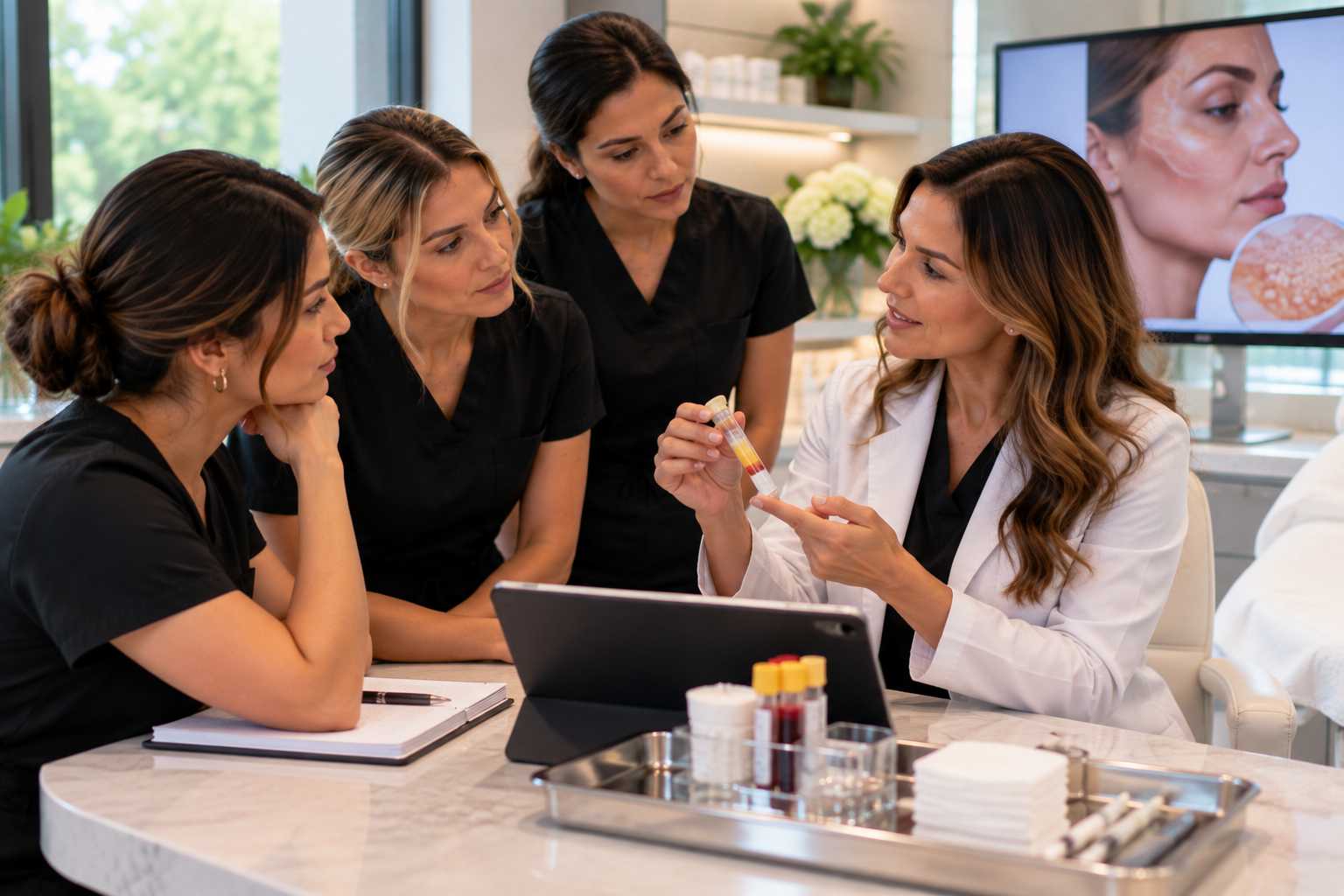
PRP is created by drawing a patient's blood and processing it to concentrate platelets, which contain growth factors involved in tissue repair. The concentrated plasma is then applied or injected into the treatment area. Results depend on preparation, technique, the area treated, and the individual patient.
Because outcomes vary from patient to patient, technique and preparation consistency matter. Providers need to understand blood draw and processing, sterile handling, injection or application methods, and how to document and evaluate results over time.
What does the evidence show?
The evidence for PRP in aesthetic and wellness applications is promising but still developing. Study quality varies, protocols differ, and results are not consistent across every patient. PRP use for many aesthetic and sexual wellness applications is also generally considered off-label. The FDA explains that off-label use means the agency has not determined that use to be safe and effective, so clear informed consent and realistic expectations are essential.
Which Patient Concerns Do Regenerative Treatments Address?
Regenerative procedures are commonly used for skin quality and facial rejuvenation, thinning hair, and sexual wellness concerns in both women and men. Each application involves its own patient selection, technique, and expectation-setting considerations.
Skin quality and facial rejuvenation
Patients concerned about dullness, texture, or early signs of aging often ask about PRP-based facial treatments. The Vampire Facial® and Vampire Face Lift® are named procedures in this category. For providers, careful assessment and honest communication about gradual, variable results are key. You can read more in how licensed professionals learn to perform PRP facials.
Thinning hair
Hair thinning affects both men and women and can have many causes. Vampire Hair Restoration® is a PRP-based approach used in some practices. Thorough evaluation matters, since some causes of hair loss call for medical workup or referral rather than an aesthetic procedure.
Female and male sexual wellness
The O-Shot® and Priapus Shot® (P-Shot®) are PRP-based procedures used in sexual wellness care. These services require respectful, clinical communication and careful expectation setting. They should never be presented as cures for incontinence or sexual dysfunction.
Which Providers Are Best Suited to Offer Regenerative Services?
Regenerative services tend to fit providers who already have a foundation in patient assessment and procedural care and who are comfortable with informed consent conversations. Physicians, nurse practitioners, physician assistants, experienced injectors, and medspa owners are commonly drawn to this area.
Physicians, especially those in women's health, primary care, or men's health, may find regenerative and sexual wellness services a natural extension of the care they already provide.
Nurse practitioners and physician assistants often lead patient education and consultations, making them well placed to guide patients through realistic expectations.
Experienced injectors who already offer neuromodulators and fillers can add regenerative options to give patients a broader, more personalized treatment menu.
Medspa owners and aspiring practice owners may see regenerative services as a way to differentiate, but they should build them on proper training, clear protocols, and honest marketing.
Registered nurses may be involved in preparing patients or supporting procedures, depending on scope and supervision arrangements.
What Does Vampire® Series Training in Needham Include?
Elite Academy's Vampire® Series Intensive Hands-On Training is an in-person course in Needham that covers a range of named PRP-based procedures. It is offered as a full-day option or a half-day option focused on the O-Shot® and P-Shot®, with class size limited to five students per session and certification through the Cellular Medicine Association.
According to the Vampire® Series course page, procedures covered include the Vampire Facial®, Vampire Face Lift®, Vampire Breast Lift®, Vampire Wing Lift®, Vampire Hair Restoration®, O-Shot®, and Priapus Shot® (P-Shot®). The small class size allows for close supervision and individual attention.
Providers who want to start with remote learning can explore O-Shot® Procedure in Detail, an online course with three clinical training videos, and The Art of the Female Sexual Wellness Consultation, which focuses on leading sensitive consultations.
Training is led by Dr. Joelle Lieman, a Board Certified Obstetrician and Gynecologist and member of the American Academy of Aesthetic Medicine. The academy's testimonials page lists providers who have completed the Vampire Series.
How Should Providers Approach Scope of Practice for PRP Procedures?
Who can perform PRP-based procedures depends on licensure, supervision, and Massachusetts board rules, and certification from a course does not by itself expand scope of practice. Confirm your responsibilities with the appropriate board before adding these services.
Physicians can review guidance through the Massachusetts Board of Registration in Medicine, and nurses and nurse practitioners through the Massachusetts Board of Registration in Nursing. Sexual wellness procedures in particular call for careful attention to scope, consent, and documentation.
Why Train in Needham?
All Elite Academy in-person training takes place at 1 Chapel St in Needham, a Norfolk County town just west of Boston. The location is accessible for providers across Greater Boston and MetroWest, and visiting clinicians can stay nearby.
The Where to Stay page lists hotels within about a 10-minute drive and notes a public lot beside the building plus metered parking on Chapel Street.
Frequently Asked Questions
What is regenerative aesthetic medicine?
It is an area of aesthetic medicine focused on treatments that support the body's own repair processes, with platelet-rich plasma being one of the most common approaches.
Is PRP FDA-approved for aesthetic use?
PRP use for many aesthetic and sexual wellness applications is generally considered off-label. Providers should explain this clearly during informed consent.
Does PRP work for hair loss?
Evidence is promising but still developing, and results vary. Hair loss has many causes, so a thorough evaluation should come before any aesthetic procedure.
Is the Vampire Series certification a board certification?
No. The Vampire Series states certification through the Cellular Medicine Association. It is not a board certification or a license.
Can I take the Vampire Series as a half-day course?
Yes. A half-day option focuses on the O-Shot and P-Shot procedures only, while the full-day option covers the broader series.
Your Own Biology, Your Next Chapter
Regenerative aesthetic medicine is not a shortcut or a miracle, and the best providers say so plainly. What it can be is a thoughtful, patient-centered addition to your practice when it rests on solid training, honest consent, and realistic expectations.
To explore the next step, visit the Vampire® Series product page, browse all Courses + Programs, or read what aesthetic medicine is and why clinicians are making the switch. For questions, contact the Elite Academy team or visit the Elite Academy homepage.


